Waiting On
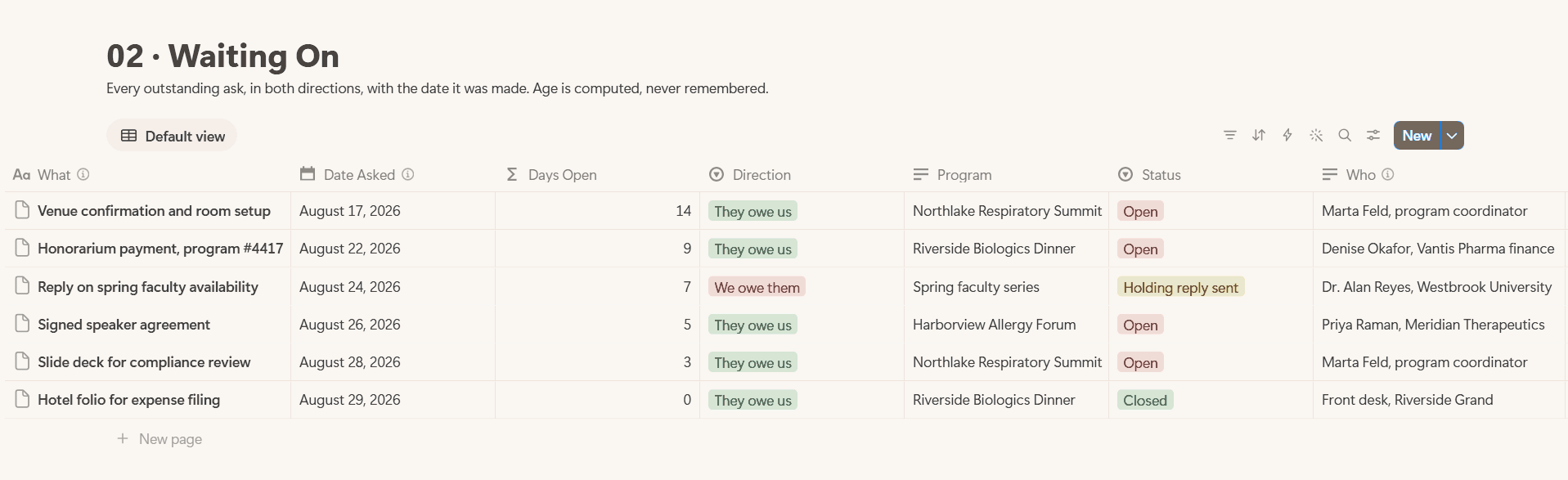
Every ask gets a date, in both directions. The clock starts the moment we ask.
You did not train for a decade to chase reimbursements at eleven at night. I run the back office behind a sponsored speaking calendar: travel, sponsor filings, and the follow-up that falls through between programs.
Every ask gets a date, in both directions. The clock starts the moment we ask.
You have double-booked clinic and a program at least once this year.
You build expense reports from memory instead of receipts.
"I'll deal with it on the plane" is a real part of your workflow.
None of that means you are disorganized. It means you are running two full-time jobs on a system built for one.
Not a filing cabinet. A system that surfaces what needs you and answers the rest itself.
Every settled fact gets one row, with the source it came from and the date it was confirmed. Once it is in there, nobody goes looking again. A new answer only wins if it arrives with a newer source.
The moment anyone is asked for anything, it becomes a row with a date. Age is computed, never remembered. It tracks what you owe others, not just what others owe you.
Seven stages from invited to paid. Nothing sits at expensed longer than two weeks. No fee passes thirty days without a chase. Break a rule and it surfaces automatically.
One message a week, same shape every time. What is done, then what only you can decide, ordered by urgency. Every item is a yes, a no, or a date. Never an open question, never "what are your thoughts on the Vienna situation." Framing it is my job, not yours.
None of these require anyone to be careless. They are what happens when volume outgrows the structure holding it.
A settled fact re-derived from scratch every week, with a fresh chance to get it wrong each time
A reply written, marked done, and never actually sent
An expense filed twice with the same sponsor, because nothing checked what was already submitted
Someone waiting weeks on a reply nobody knew was owed
How to build a system that holds the answer, so nothing falls through while you're on a plane

The architecture I run for high-volume physician-speakers, written so you can build it in a weekend without me.
Thirty minutes on a call, then a written scorecard within two days: your four layers scored, the three highest-value fixes ranked, and an honest mark against each saying whether you can do it yourself.
Record, Track, Stage and Deliver each scored out of five, in your own words, with the specific gaps named. Everything marked self-serve comes with full instructions.
If you take the scorecard and fix it all without me, that is a good outcome. If the ongoing part is where you are stuck, we can talk about that separately.
I came to this through bookkeeping, where a missed filing is not an inconvenience, it is money. That is the habit of mind I bring to sponsor reimbursements and program logistics: reconcile it, source it, and never assume a thing happened because someone meant to do it.
I started my own practice because I needed real control over my own schedule. Three children and a household that homeschools will teach you, quickly, that a calendar either runs on a system or it runs you. That turned out to be the work I love.
Now I do it for physicians whose calendars have outgrown what any one person can hold in their head.
What I handle
Travel booking and changes. Sponsor reimbursements and expense filings, with an ownership check before anything is submitted. Program correspondence and the holding replies that keep relationships warm. Contract and fee tracking through to payment. A weekly decision queue built for how you actually work.
Bookkeeping clients: my practice at Cornerstone Bookkeeping continues as always.
Thirty minutes, no pitch. We look at where your operation actually leaks and what it would take to close it. If it turns out you don't need me, I'll tell you that.
Book a call